


 +919011100010
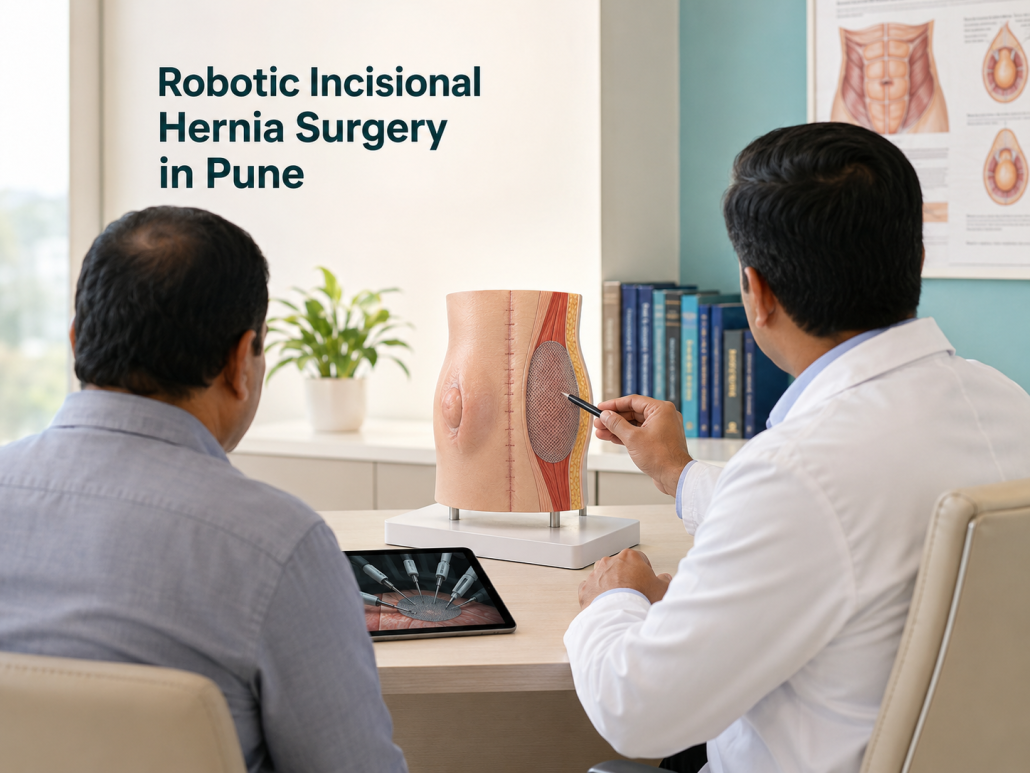
Robotic Inguinal Hernia Surgery in Pune | Doss India
DOSS India provides clinical evaluation and surgical planning for adults considering robotic inguinal hernia surgery in Pune. An inguinal hernia develops when fat, intestine or another abdominal tissue pushes through a weak area in the lower abdominal wall and produces a bulge or discomfort in the groin. Robotic-assisted repair is one minimally invasive option for selected patients; it is not automatically more suitable than laparoscopic or open repair.
Dr. Neeraj Rayate and Dr. Satish Pattanshetti assess the side and type of hernia, symptoms, reducibility, previous operations, general health, occupation and activity goals before recommending observation or surgery. When an operation is appropriate, the consultation should explain the reasonable open, laparoscopic and robotic options, the expected role of mesh, material risks, recovery and cost.
Book a hernia consultation: Speak with the DOSS India surgical team for an individual assessment of a groin swelling, pain or previously repaired inguinal hernia.
What Is an Inguinal Hernia?
An inguinal hernia is a protrusion through a weak area in the groin region of the abdominal wall. It develops near the inguinal canal, a natural passage in the lower abdomen. The hernia may contain fatty tissue, a hernia sac or a loop of intestine.
The swelling may appear on the right, left or both sides. It often becomes more noticeable while standing, coughing, lifting or straining and may reduce or disappear when lying down. A hernia that can be gently returned to the abdomen is described as reducible. A hernia that becomes trapped and cannot be reduced requires prompt assessment, particularly when pain or digestive symptoms are present.
An inguinal hernia is not the same as a femoral hernia, enlarged lymph node, hydrocele, lipoma, muscle strain or another cause of groin pain. The distinction can be especially important in women because a femoral hernia may be less obvious on examination and has a different risk profile.
For information about other abdominal-wall defects, read about hernia treatment in Pune at DOSS India.
Common Symptoms of an Inguinal Hernia
Some inguinal hernias cause an obvious groin bulge, while others produce pressure or discomfort without a large swelling. Symptoms may come and go and are often more noticeable later in the day or after physical activity.
Possible symptoms include:
A bulge on one or both sides of the groin
- Aching, burning, pressure, heaviness or a pulling sensation
- Discomfort while coughing, bending, lifting, exercising or standing for long periods
- A swelling that becomes larger on straining and smaller on lying down
- Pain or restriction during work, walking, sport or routine activity
- Scrotal swelling or discomfort when a larger hernia extends downward in a man
- Groin pain or a new bulge after an earlier inguinal hernia repair
Groin pain without a bulge is not always caused by a hernia. Hip conditions, adductor injury, nerve pain, urinary problems, testicular conditions and other diagnoses may produce similar symptoms. Examination is important before surgical treatment is discussed.
Seek urgent medical care: Sudden severe or rapidly increasing pain, repeated vomiting, abdominal swelling, inability to pass stool or gas, fever, a firm bulge that cannot be pushed back, or red, purple or dark skin over the swelling may indicate obstruction or loss of blood supply to trapped tissue. These symptoms should not wait for a routine clinic appointment.
Direct, Indirect, Bilateral and Recurrent Inguinal Hernias
An indirect inguinal hernia passes through the internal inguinal ring and follows the natural canal. The underlying weakness may be present from birth, although symptoms can first appear in adulthood. A direct inguinal hernia pushes through a weakened area in the back wall of the inguinal canal and is more often associated with acquired tissue weakness.
A unilateral hernia affects one side, while a bilateral inguinal hernia is present on both sides. One side may be more symptomatic than the other. A recurrent inguinal hernia develops after a previous repair. Planning a recurrent repair requires review of the earlier approach, scar tissue, mesh position, current anatomy and the cause of present symptoms.
These labels describe anatomy, but they do not by themselves select the operation. The surgeon also considers defect size, scrotal extension, reducibility, pain, age, anaesthesia fitness and previous lower-abdominal or pelvic surgery.
Why Do Inguinal Hernias Develop?
An inguinal hernia develops through a combination of abdominal-wall weakness and pressure from inside the abdomen. In some people, the weak area has existed since birth. In others, connective tissue changes with age or repeated strain contribute over time.
Associated factors can include family history, increasing age, chronic cough, smoking, constipation, repeated straining during urination, heavy physical work, pregnancy, connective-tissue disorders, previous groin hernia and certain abdominal or pelvic operations. Excess body weight can complicate assessment and surgery, although an inguinal hernia can occur at any body size.
Lifting may reveal or worsen the symptoms of an existing weakness, but a single lifting episode is not always the complete cause. Treating chronic cough, constipation or urinary obstruction can reduce ongoing strain and improve preparation, but lifestyle measures cannot close an established adult hernia defect.
Does Every Inguinal Hernia Need Immediate Surgery?
No. Surgery is generally advised when an inguinal hernia is painful, enlarging, difficult to reduce, limiting daily activity or associated with concerning symptoms. A recurrent, bilateral or scrotal hernia may also warrant surgical review even when the symptoms are not severe.
Watchful waiting may be reasonable for selected men with an asymptomatic or minimally symptomatic, easily reducible inguinal hernia when normal activities are not limited and the person understands warning signs. Many people eventually choose surgery if pain or restriction develops, so observation should include a plan for reassessment rather than ignoring the condition.
Watchful waiting is not appropriate for every patient. Symptomatic hernias require surgical assessment, and women with a groin hernia generally need timely specialist review because a femoral hernia can be missed and may carry a greater risk of complications. Pregnancy, major medical conditions and anaesthesia risk require individual advice.
A truss or hernia belt may provide temporary support for some patients but does not repair the opening. The purpose of consultation is to decide whether an operation is needed, when it should be performed and which approach offers a reasonable balance of benefit, risk and cost.
How Is an Inguinal Hernia Diagnosed?
Diagnosis usually begins with a detailed history and physical examination. The surgeon may examine the groin while the patient is standing and lying down and may ask the patient to cough or gently strain. The assessment considers the side of the swelling, reducibility, tenderness, scrotal involvement and whether a femoral or contralateral hernia may be present.
Imaging is not required for every obvious inguinal hernia. Ultrasound may be useful when the swelling is small, symptoms are intermittent, the examination is uncertain or another groin condition is possible. CT or MRI may be considered for an occult, recurrent or complex hernia, unexplained persistent pain or preoperative planning. Scans should answer a clinical question rather than replace examination.
If surgery is being considered, the assessment may also include blood tests, ECG, anaesthesia evaluation and review of diabetes, heart or lung disease, urinary symptoms, smoking, medicines and previous reactions to anaesthesia. Bring earlier operative notes, discharge summaries and mesh information when available.
What Is Robotic Inguinal Hernia Repair?
Robotic inguinal hernia repair is a form of minimally invasive surgery. The surgeon performs the operation through small abdominal incisions while seated at a console and directly controls a magnified camera and articulated instruments. The robotic system does not operate independently, decide where to place mesh or replace the surgeon’s judgement.
Many robotic groin hernia repairs use a transabdominal preperitoneal approach, often called robotic TAPP. The surgeon enters the abdominal cavity, opens the lining over the groin, reduces the hernia and creates space behind the muscles for mesh. The peritoneal lining is then closed over the repair. The exact technique may differ according to anatomy and surgeon planning.
The platform can provide a magnified three-dimensional view and wristed instruments that support precise dissection and suturing. These technical features may be useful in selected bilateral, recurrent or anatomically demanding repairs. They do not guarantee less pain, zero complications, quicker recovery or a lower recurrence rate for every patient.
Learn more about the broader role and limitations of robotic surgery in Pune at DOSS India.
What Happens During Robotic Inguinal Hernia Surgery?
The procedure is generally performed under general anaesthesia. After the small ports are placed, the abdomen is inflated with carbon dioxide to create working space. The surgeon identifies the hernia and important structures in the groin, returns protruding tissue to the abdomen and carefully separates the hernia sac.
A preperitoneal space is developed so that mesh can cover the complete groin region, including the potential sites of direct, indirect and femoral hernias. The mesh type, size and method of fixation are chosen according to the defect and surgical plan. In selected cases, fixation may not be required; larger medial defects or other anatomical factors may change that decision.
The peritoneum is closed over the mesh, and the instruments and ports are removed. If unexpected scar tissue, bleeding, bowel involvement or another safety issue prevents completion of the planned repair, the surgeon may modify the operation or convert to a conventional laparoscopic or open approach.
If an unexpected hernia is seen on the opposite side, repair should not be assumed automatically. The possibility of inspecting or treating the other side should be discussed during consent because repairing an occult defect adds dissection and may expose a patient to risks for a hernia that might never have caused symptoms.
Who May Be Considered for a Robotic Approach?
A robotic approach may be discussed for an adult with a confirmed inguinal hernia when a minimally invasive posterior repair is clinically suitable and the required platform and surgical expertise are available. It may be considered for selected bilateral hernias, a recurrence after a previous open repair, or a case in which articulated dissection and suturing may assist the planned operation.
Suitability is not decided by the presence of a groin bulge alone. The surgeon considers whether the hernia is primary or recurrent, unilateral or bilateral, reducible or scrotal, as well as the patient’s age, weight, medical conditions, urinary symptoms, previous abdominal or pelvic operations, anaesthesia risk and work demands.
An open repair may be more appropriate for some patients who cannot have general anaesthesia, have a very large or irreducible scrotal hernia, or have anatomy that makes a minimally invasive posterior approach less suitable. Conventional laparoscopy can provide an effective minimally invasive repair for many patients without the additional robotic resources.
Robotic inguinal hernia surgery in Pune should therefore be recommended because it fits the individual repair plan, not simply because a robotic system is available.
Robotic vs Laparoscopic vs Open Inguinal Hernia Repair
Open repair is performed through an incision in the groin. The surgeon returns the hernia contents and repairs the weak area, usually with a flat mesh in an adult. Open surgery may be performed under local, spinal or general anaesthesia depending on the technique, patient and hospital. It remains an established option for many primary unilateral hernias and for selected large or complex cases.
Laparoscopic repair uses a camera and long instruments through small abdominal incisions. The commonly used posterior approaches are TEP and TAPP. When expertise and resources are available, laparo-endoscopic repair can offer quicker recovery and a lower risk of chronic pain than open repair for appropriate patients. It is often considered for bilateral hernias and recurrence after an earlier open repair.
Robotic repair is a robotic-assisted laparoscopic operation. It provides articulated instruments and a three-dimensional view but may require additional operating time, equipment and cost. Current comparative evidence has not established that robotic repair is universally superior to standard laparoscopy for recurrence, pain or complications. The most appropriate conclusion is that open, laparoscopic and robotic techniques are options whose value depends on patient factors, hernia anatomy, surgeon experience, local resources and informed preference.
DOSS India also provides laparoscopic GI surgery in Pune, allowing the operative approach to be selected according to clinical need rather than a single platform.
Is Mesh Used in Robotic Inguinal Hernia Repair?
Mesh is used in most adult inguinal hernia repairs because reinforcement lowers recurrence risk compared with many suture-only techniques. In minimally invasive repair, a flat mesh is usually placed in the preperitoneal plane behind the groin muscles so it covers the hernia defect and nearby areas of potential weakness.
Mesh is not a brand claim or a guarantee. The surgeon should explain why mesh is recommended, the intended position, available alternatives and relevant risks. Mesh-related complications can include infection, folding, migration, adhesion, persistent discomfort or the need for further treatment, although these are not expected in every patient.
A non-mesh repair may be discussed for carefully selected patients when appropriate expertise is available and the patient understands the trade-offs. The Shouldice technique is the best-established tissue repair, but it is not a robotic procedure. A patient’s preference about mesh should lead to a balanced conversation rather than dismissal or an automatic promise of a mesh-free repair.
Why Choose DOSS India for Inguinal Hernia Care?
DOSS India is a Pune-based surgical centre focused on hernia, bariatric and minimally invasive gastrointestinal surgery. The team evaluates the diagnosis, previous operations and complete groin anatomy before recommending a technique.
Dr. Neeraj V. Rayate is an MBBS, MS and DNB-qualified laparoscopic and robotic surgeon. His training listed by DOSS India includes fellowship training in GI and onco surgery, endoscopic surgery and robotic surgery. His practice includes laparoscopic, robotic, gastrointestinal and abdominal-wall surgery.
Dr. Satish Pattanshetti is an MBBS and MS-qualified laparoscopic bariatric and metabolic surgeon with fellowship training in minimal access and bariatric surgery. Dr. Rayate and Dr. Pattanshetti contribute complementary experience when a primary, bilateral or recurrent hernia would benefit from collaborative planning.
The availability of open, laparoscopic and robotic approaches allows the recommendation to begin with the patient’s condition rather than a single technology. Patients should understand the planned operative plane, mesh considerations, alternatives, material risks, recovery and likely cost before giving consent. Read more about DOSS India and its surgical team.
Preparing for Robotic Inguinal Hernia Repair
Preparation begins with confirming the diagnosis and addressing health factors that can affect anaesthesia, wound healing or recurrence. The surgeon may advise better control of diabetes, treatment for chronic cough, constipation or urinary obstruction, smoking cessation, nutrition review or weight management when relevant.
Tell the team about blood thinners, diabetes medicines, weight-loss medicines, supplements, allergies, heart or lung conditions, sleep apnoea and previous anaesthesia problems. Do not stop prescribed medication without instructions from the surgeon or anaesthetist. Follow the hospital’s fasting guidance and arrange transport and help at home after discharge.
Before surgery, ask which approach is planned, whether one or both sides will be assessed, which mesh position is intended, what could change the plan during the operation and which costs are included. Bring earlier scan images, operative notes and implant details if the hernia has been repaired before.
Recovery After Robotic Inguinal Hernia Surgery
Recovery varies with the side and size of the hernia, unilateral or bilateral repair, previous surgery, general health, pain response and type of work. Many uncomplicated repairs may be managed as day surgery or with a short hospital stay, but discharge depends on pain control, walking, urination, nausea and the hospital’s criteria.
Early walking is usually encouraged. Temporary soreness, bruising, groin tightness, scrotal or labial swelling and a small fluid collection can occur. These changes often settle gradually, but increasing pain, redness, fever, persistent vomiting or difficulty urinating should be reported.
Follow the individual instructions for wound care, bathing, driving, office work, exercise and lifting. A desk-based worker may return sooner than someone whose job involves repeated lifting or strenuous activity. External incisions can look healed before deeper tissues have recovered, so activity should be increased progressively according to comfort and the surgeon’s advice.
Follow-up is used to review wounds, swelling, pain, urinary function and gradual return to activity. Persistent groin pain, numbness, testicular symptoms or a recurrent bulge should be assessed rather than accepted as a normal long-term result.
Possible Risks and Limitations
All inguinal hernia operations have risks, including minimally invasive procedures. The consent discussion should reflect the patient’s anatomy, health and planned repair. Relevant risks may include:
- Bleeding, infection, blood clots or complications related to general anaesthesia
- Seroma, bruising, scrotal or labial swelling and wound problems
- Temporary or persistent difficulty passing urine
- Injury to the bowel, bladder, blood vessels, nerves, spermatic cord or testicular vessels
- Persistent groin pain, numbness, altered sensation or discomfort during movement
- Testicular pain, reduced blood supply or atrophy, which is uncommon but important to discuss
- Mesh infection, folding, migration or another mesh-related complication
- Hernia recurrence or development of a hernia on the opposite side
- Conversion to laparoscopic or open surgery when required for safety
- Need for further treatment or another operation
Robotic technology may assist the surgeon with visualisation and instrument movement, but it cannot eliminate these risks or guarantee a painless recovery and permanent result.
Groin Pain After Hernia Repair
Some pain is expected during early recovery, but pain that continues for months deserves assessment. Chronic postoperative inguinal pain may be related to nerve irritation, mesh or fixation, scar tissue, recurrence, hip or muscle problems, or another diagnosis. The cause is not always visible on a routine scan.
Risk reduction begins with careful patient selection, appropriate technique, knowledge of groin nerves and realistic preoperative counselling. Treatment may include examination, imaging when indicated, medicines, physiotherapy, pain-specialist input, nerve procedures or further surgery in selected cases. No surgical approach can promise zero risk of chronic pain.
Cost of Robotic Inguinal Hernia Surgery in Pune
The cost of robotic inguinal hernia surgery in Pune cannot be confirmed responsibly without examining the patient and defining the procedure. Cost may vary with unilateral or bilateral repair, primary or recurrent hernia, scrotal extension, investigations, mesh, robotic consumables, hospital and room category, anaesthesia needs, medical conditions and length of stay.
After assessment, the team can provide a case-specific estimate and explain what is included. Insurance coverage depends on the policy, waiting periods, medical necessity, hospital network, room eligibility and pre-authorisation terms. A robotic procedure should not be selected only from an advertised package price or an assumption that a higher price guarantees a better result.
What to Expect at Your DOSS India Consultation
The surgeon reviews the groin swelling or pain, its effect on activity, medical conditions, medicines and previous operations.
The groin is examined while standing and lying down to assess the side, reducibility, tenderness and possible femoral, bilateral or recurrent hernia.
Existing scans and operative records are reviewed, and imaging is requested only when it will answer a useful clinical question.
You receive an explanation of whether observation or surgery is appropriate and whether open, laparoscopic or robotic repair is a reasonable option.
If surgery is planned, the approach, possible treatment of the other side, mesh position, alternatives, risks, expected recovery and estimated cost are discussed.
Book a Consultation for Robotic Inguinal Hernia Surgery in Pune
If you have a painful or enlarging groin bulge, discomfort that restricts work or exercise, a swelling on both sides or symptoms after an earlier repair, a structured surgical assessment can clarify the diagnosis and available options. Consult the DOSS India team to find out whether robotic inguinal hernia surgery in Pune is suitable for your condition or whether another approach would be more appropriate.
DOSS Clinic: OPD No. 5, Jupiter Hospital Lane, 3 Baner-Balewadi Road, Prathamesh Park, Baner, Pune, Maharashtra 411045
Phone: +91 90111 00010 / 020 27992799
Appointments: Contact DOSS India
Medical disclaimer: This page provides general educational information and does not replace consultation, examination, diagnosis or treatment by a qualified medical professional. Treatment recommendations, risks, cost and recovery vary. Seek urgent medical care for severe or rapidly worsening symptoms.